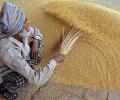
India's opening stocks of wheat in the central pool are expected to be 19.5-20 million tonnes as on April 1, 2022, the lowest in the last three years, but much higher than the normative level required for maintaining a buffer and strategic reserve, trade and market sources said. In accordance with the buffer and strategic reserve norms, India should have a wheat stock of 7.5 million tonnes in the central pool as on April 1 each year and this year's stocks, though the lowest in the last three years, will still be over 160 per cent more than what is required. On the export front, both government and trade sources are unanimous that this year (FY22) they will be 7-7.25 million tonnes, a record, while in the next financial year, they might touch even 10 million tonnes if the current momentum is maintained.

Seven months after it was launched in India, Apple is expected to start manufacturing the iPhone 13 at the Foxconn plant in Sriperumbudur near Chennai from April, according to sources. The phones will be for both the domestic and export market. The production of the iPhone 13 in the Chennai plant was meant to start from January but had to be postponed after Apple suspended production following protests in December by women workers about food poisoning. An Apple spokesperson did not respond to an e-mail query.

India's wheat exports could touch a new record of 10 million tonnes in 2022-23, up from a record seven million tonnes in the current financial year, if global market conditions remain choppy and no curbs are imposed on outbound shipments. That is the bullish estimate by officials from global trading firms and market watchers who say the Russia-Ukraine crisis has not only attracted global buyers to India but also pushed the price of Indian wheat from around $320 per tonne (FOB) to over $360 per tonne in less than 10 days. Food secretary Sudhanshu Pandey told reporters that wheat exports till February-end have already reached 6.6 million tonnes and by the end of March, outbound shipments will reach seven million tonnes.

Oberoi Realty has hit the top slot in Mumbai's ranking of the top-20 developers in terms of sales in 2021, evicting the Runwal group which was number one last year. The Lodha group which had occupied the top slot three out of five times since 2017 slipped to second place in 2020 and continues to be in the same position in 2021. The Oberoi group was in fifth place in 2019 and fourth place in 2020. This is the first time that it has occupied the number one position. The Runwal group which took the top slot in 2020 is down to third place in 2021.
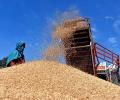
India is looking to tap its diplomatic missions abroad to enable grain exporters in the country to ship out wheat and corn as supplies from Russia and Ukraine are expected to remain disrupted for some time to come. Between the two items, pushing for wheat is easier because of a huge domestic surplus. "We are hand holding our exporters and support from various Indian missions abroad is also being channelised accordingly," a senior government official said. Global wheat prices have jumped since the Ukraine crisis started, with wheat futures in the US reaching their highest levels since 2008.

In the three months leading up to the Assembly elections, Chief Minister Yogi Adityanath's government distributed over 1.4 million tonnes (MT) of wheat, 0.95 MT of rice, 0.10 MT of chana (gram), 101.9 million litres of soybean oil and 100,000 tonnes of salt as free ration. This was part of the Covid relief package, officials said.

Reliance Industries has put together an aggressive plan to build its drone business which includes expanding manufacturing capacity five-fold, participating in the new drone production linked incentive scheme, and experimenting with limited logistics payloads to deliver goods. The target is to become a key player in the expected $5 billion market in India by the end of the decade. The drone business is being carried out through a Bangalore-based start up, Asteria Aerospace, in which Reliance has taken a majority stake. Asteria is a subsidiary of Jio Platforms Ltd.

Chinese giant Xiaomi is going for the premium segment with a view to grabbing market share in the Rs 20,000 to Rs 50,000 smart phone market as well as having offerings up to Rs 70,000 where players like One Plus, Samsung, Vivo and Apple are key players. "Two years ago, the Rs 20,000 plus smart phone market which is considered premium in India was very small. "Out of every 100 phones sold, only 10 were above this price mark. "However, in the last two years, it suddenly grew and we thought it was big enough for us to focus on now," said Manu Kumar Jain, managing director, Xiaomi India.

Though early days, meteorologists point towards a neutral La Nina during the initial phase of the four-month monsoon season this year that starts from June. If this holds true, by the time the rains hit the mainland, it could mean there would be one less reason to worry about the prospects of the monsoon this year. Weathermen said making any accurate prediction of how El Nino will behave and what impact it can have on the progress and distribution of rains is difficult to say at this point. A clear picture will emerge around late May or early June.


The onslaught of Chinese mobile brands is virtually obliterating Indian brands, especially in terms of value. According to industry estimates based on excise and Custom duty trends, the value share of Indian brands (across smartphones and feature phones, operator phone sales - which is mostly Jio phones - and the value of phones smuggled into the country) has dropped to a mere 1.2 per cent in January-October 2021 compared to 25.4 per cent in the calendar year 2015. In the same period, the Chinese have established their domination, hitting a value share of 64.5 per cent, up from 17.8 per cent.

The Centre has, perhaps for the first time, decided to provide funding support to farmer-producer organisations, krishi vigyan kendras, custom hiring centres, and individuals for purchasing them.

More and more PE players are willing to test the waters now, just in case they become early entrants in a future booming business.

The government's food subsidy in the ongoing fiscal year is expected to be a little less than Rs 4 trillion.

'There is definitely a skill war, or a talent war going on.'

The government is looking at a time frame within the first two weeks of July to kick off and complete the upcoming 5G auctions, according to discussions between officials and stakeholders. It is expected that the Telecom Regulatory Authority of India (TRAI) will give its recommendations on the base price by March, after which the necessary cabinet clearances will be given. The Department of Telecommunications (DoT) had earlier looked at undertaking the auction in the first quarter of 2022 but decided to push it back. Communications Minister Ashwini Vaishnaw had also said that the auctions are likely to take place in April-May.

'Last year we sold 18 million phones in India, this year we should do 23-24 million, and next year our target is to hit 40 million.'

With the spectrum auction now delayed till at least next May, the expected 5G orders for telecom equipment have not been sealed, the companies point out. Surajeet Das Gupta reports.

Of the amount, the home-grown private equity player founded by Renuka Ramnath plans to deploy $8 billion in various companies as part of its blueprint for growth.

Mobile device maker Realme has overtaken South Korean giant Samsung to grab the second spot in the branded smartphone market, with 18 per cent volume share in October this year, revealed Counterpoint Research. Its rival Samsung ended October with 16 per cent share. Xiaomi (including its brand POCO) was at 20 per cent; Vivo at 13 per cent. The ascent brings Realme closer to its ambition to reach the No. 1 berth by 2022 when it hopes to sell over 40 million smartphones annually.
 © 2026 Rediff.com - Investor Information - Advertise with us - Disclaimer - Privacy Policy - Sitemap - Feedback - About us - Terms of use - Grievances